 0845 8623840
Insights
The Case for NNLW: The Simplest and Safest Fix for Asbestos Confusion
Date: 19/01/26
The HSE’s recent consultation on the Control of Asbestos Regulations 2012 presented a three-point plan to tighten asbestos safety by addressing systemic weaknesses. We would like to share with you some of our feedback on the third pillar, which seeks to “clarify the type of work that constitutes work with asbestos, known as Notifiable Non-Licensed Work (NNLW)” to eliminate the long-standing ambiguity in the current rules. The HSE's objective is to provide greater clarity around NNLW, ensuring that dutyholders understand the requirements for notifying asbestos work, designating identified work areas, undertaking medical surveillance, and maintaining health records.
114. The policy options considered by HSE are outlined below:
Option 1 - To improve guidance and use other interventions to clarify the type of work that constitutes work with asbestos known as NNLW
Option 2 - To amend CAR 2012 to remove NNLW as a category of work with asbestos
Option 3 - To amend the definition of what constitutes NNLW so this type of work does not include higher risk materials including asbestos insulation or asbestos insulating board*
Improving clarity around Notifiable Non-Licensed Work is both welcome and long overdue; however, it raises significant questions associated with Non-Licensed Work (NLW). Both NNLW and NLW rely on risk-based interpretation. The nature of the task (maintenance, removal, encapsulation, sample collection, etc.), as well as the type and condition of the material, are subjective and open to interpretation. If this work is categorised as non-licensed, it therefore goes unmonitored. If we’re serious about clarity and protection, NLW is the weak link that requires scrutiny. In fact, removing NLW and channelling all non-licensed work through the NNLW framework would significantly strengthen dutyholder confidence, improve accountability, and reduce real-world risk.
Grey Areas Create Real-World Risks
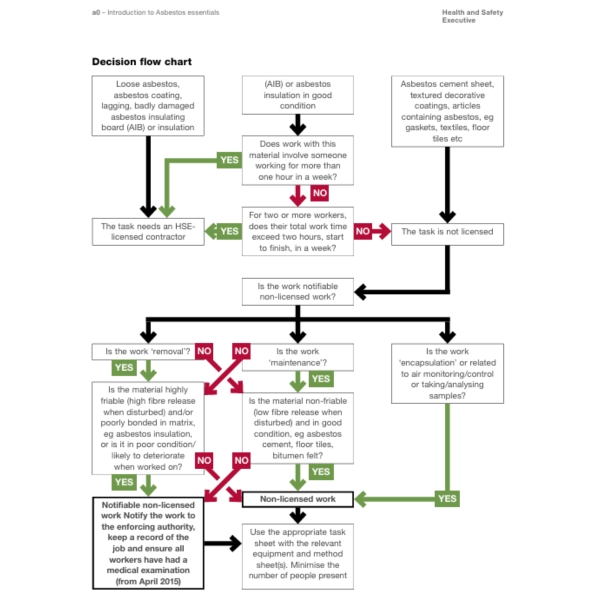
Determining whether work qualifies as NLW or NNLW is widely regarded as a complex task (see image below from HSE guide HSG210 – A0).** Non-licensed work is typically deemed low risk, and while strict safety guidelines still apply, many contractors assume unlicensed means safe. Asbestos remains the UK's leading occupational killer. Unlicensed work is a known point of exposure; without appropriate measures in place, NLW could continue to contribute to asbestos exposures if the work isn’t controlled safely.
NLW is a category where dutyholders guess, contractors interpret, surveyors disagree, and enforcement varies. Eliminating it would remove a major source of inconsistency in CAR 2012. Notifying all asbestos work regardless of risk would ensure oversight and accountability exist, providing a significant uplift in transparency and standards.
Strengthening Stakeholder Confidence
The HSE's intention to provide better examples and clear criteria is a much-needed and welcome step. However, it won't prevent the misclassification and inconsistencies found in NLW. Within the consultation (ref. 109), the HSE's own data confirms that notifiers often confuse what is licensable and non-licensable work. “A significant proportion of notifications for work on asbestos insulating board (AIB) (short duration) and asbestos insulation (AI) (short duration) work exceeds the short duration timeframe and should therefore be notified as licensable work.” Consequently, clarity around what is and isn’t notifiable cannot always be assumed.
Furthermore, in 111 of the consultation, the HSE explicitly states, "Any NLW that doesn’t meet the definition of licensable work or non-licensable work will be, by default, NNLW." It should be alarming for anyone involved in occupational safety that NNLW is simply considered a default category and that the consultation proposes an option to remove it.
NLW still involves high-risk conditions, particularly if they go unchecked, yet this category offers no mechanism for oversight or monitoring from the regulator. Notification forces a moment of scrutiny and delivers a traceable record of how the work was carried out. A single, notifiable non-licensed category would establish a unified set of controls and a consistent process to follow. It would remove the guesswork and grey areas, giving increased confidence and collaboration among all stakeholders.
Notification Drives Compliance
Making all non?licensed work notifiable initiates a step change in the way the industry considers and manages asbestos?containing materials. When a process demands transparency, people make safer choices. The psychological and administrative steps would compel dutyholders and contractors to recognise and acknowledge the very real risks associated with any asbestos exposure.
Many health and safety failures stem from unchecked assumptions, poor oversight and diluted responsibility. Notifications and transparency reinforce accountability, reduce informal risk-taking and instil a culture where safety is actively managed.
In conclusion, if a material contains asbestos, the HSE should be informed. A universal notification would give regulators greater visibility, allow earlier intervention, and provide a more accurate national picture of asbestos risk. While NNLW would slightly increase the administrative burden on the HSE, it would replace ambiguity with accountability and help future-proof the industry by providing an effective, long-term solution to the UK's asbestos legacy.
* Legislative and guidance proposals for the Control of Asbestos Regulations 2012
** HSE guidance HSG210, extract from page 6 of A0-Introduction to Asbestos Essentials.
Images
Click an image to enlarge: