 0845 8623840
Insights
From Policy To Practice
Date: 20/05/26

Embedding Safety in Everyday Actions and Choices
Having robust policies, procedures and risk assessments in place is important for health and safety, but are you actually creating safe working environments? Embedding policies is just the start; safe environments are created when people behave responsibly, even when no one is watching! Rachel Wetherill explains the importance of going beyond paperwork to create high-trust, interdependent environments where teams collectively own safety and embed responsible behaviour as a shared value.
A responsible organisation should have the appropriate policies, procedures and risk assessments in place to ensure compliance, but paperwork alone does not keep people safe. What really makes a difference is how effectively these frameworks are embedded in the operational culture. Policies must be translated into practice so that safety becomes an integral part of everyday decisions and actions. A successful safety strategy can only be achieved when people act with integrity and accountability, even when no one is watching.
A strong and ethical health and safety culture can benefit businesses in many ways. Employees who feel safe at work and are surrounded by competent, well-supported colleagues are generally more focused, motivated and committed. Organisations operating with positive cultures tend to experience the following:
- Fewer accidents, incidents and near misses.
- Reduced downtime, disruptions and associated costs.
- Higher levels of employee morale, trust and engagement.
- Better productivity and quality of work.
- A positive reputation with industry, customers and regulators.
A positive safety culture starts with leadership. Employees take their cues from the behaviours they see at the top of an organisation. At iON Consultants, we offer top-down training programmes to ensure that everyone within a business – including management – understands what is expected of them. The impact is genuinely powerful, as it promotes an environment where safety is prioritised and openly discussed.
Policies and best practices go hand in hand, but every safe outcome begins with someone choosing to do the right thing. Effective risk management requires both robust documentation and a proactive culture. Policies and procedures provide clarity, but they can only be implemented effectively by people applying them consistently. When a safety culture is most effective, paperwork becomes a useful tool rather than an administrative burden. It facilitates communication, accountability and continuous improvement. When individual choices are guided and reinforced by clear policies and a shared commitment to best practices, safety becomes more than a requirement; it becomes a habit embedded in everyday behaviour.
The Bradley Curve
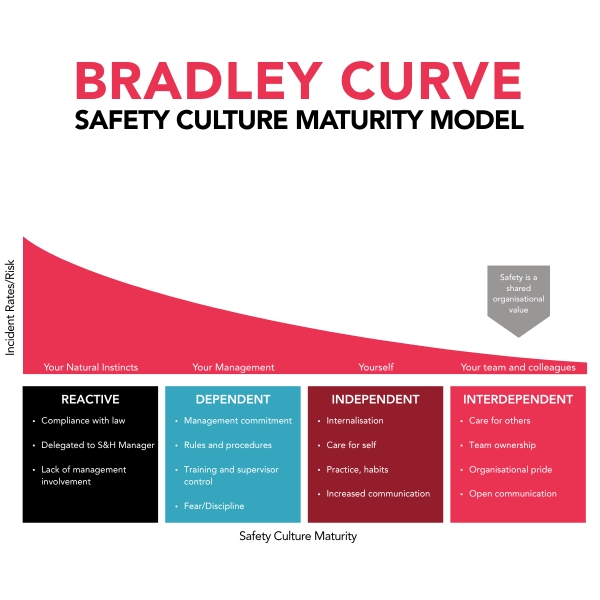
The Bradley Curve illustrates the maturity of an organisation's safety culture across four stages: reactive, dependent, independent, and interdependent. In the early stages, safety is mainly driven by rules, supervision and enforcement – it is often incident-driven, and people comply because they must. As the culture matures, individuals begin to take responsibility for their safety, understanding how their actions influence risk. Organisations ultimately reach a high-trust, interdependent stage where teams collectively own safety, look out for one another, continuously improve safety systems, and embed safe behaviours as a shared value.
Having reviewed the illustration below, ask yourself:
- Where does our organisation currently sit on the curve?
- Where would our employees place us?
- Where do we want to be in the next one to two years?
- What actions will move us toward that goal?
Health and safety paperwork is essential, but it is only the foundation. Real safety culture comes from embedding those requirements into everyday actions, decisions, and conversations. This means integrating safety practices into all aspects of work life, rather than treating them as separate tasks.
Progress requires a structured plan — and that’s where we come in. We can help you develop a tailored improvement plan aligned with your desired position on the Bradley Curve. We can help you define clear milestones and responsibilities and measure progress. If this sounds right for your organisation, please contact us.
Images
Click an image to enlarge: